While traveling, I decided to ask a bunch of people the same three questions. This ended up being an amazing way to get to know people from all over the place. Hope you enjoy!
Around the World in Three Questions

While traveling, I decided to ask a bunch of people the same three questions. This ended up being an amazing way to get to know people from all over the place. Hope you enjoy!
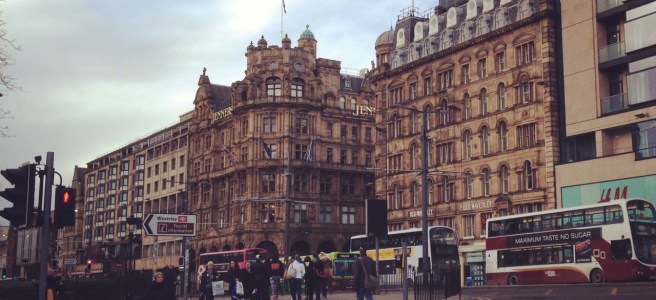

STARBUCKS WIFI
Good free WiFi is hard to find. A Scottish woman joked with me that only 3% of Scotland has real high-speed internet. Regardless, Starbucks will always get you free WiFi and outlets to plug your devices into. There are a bazillion Starbucks in Edinburgh. The most spacious one I’ve encountered so far in on Princes St. Waverly Station Starbucks is quite cozy and generally a bit warmer, which may be important in the winter. The central Starbucks in Old Town (off High Street) is nice as well, but generally more crowded.
OTHER WIFI
McDonald’s has free WiFi as well, but you need to go through a verification process that involves them sending you a verification code via SMS, which you may or may not be able to receive depending on your phone’s messaging plan. Waterstones Cafe on Princes is also quite roomy and offers free WiFi (faster than Starbucks) without requiring a password. The Central Library in Edinburgh has free WiFi as well, but you have to enter a library membership number in order to reach it. The Cafe inside the Main Library has 4-5 computers with fast internet. Hostels generally have free WiFi, but they are as slow as winters in Boston. Some hostels have multiple WiFi hotspots. Find the one closest to you; don’t assume the one you used in the main lounge (e.g. “Hostel Free”) is the best one.
TRAVEL
Get up early, especially if you want to travel to neighboring cities. Edinburgh to Glasgow: £9.50 / Edinburgh to Stirling: £12.50 / Bus in Edinburgh: £1.50 / Bus in Glasgow: £1.20 or £1.90 depending on distance / Bus prices vary in St. Andrews, Stirling.
Umbrellas are definitely necessary in a downpour, but not particularly useful during the short bursts of drizzle and light rain Edinburgh daily. Get a good hat instead that will keep your head dry and warm.
CONVERSATION
For Americans: “Hiya” = “Hey there, how’s it going.” and “Sitting in or taking away?” = “For here or to go?”
Talk to people you don’t know, whether its shopkeepers or other hostel residents. They won’t all be from the city you’re in. You’ll find travelers from everywhere. If you don’t know how to start a conversation, I recommend starting with a question.
Use “Globish” (Global English) with non-native English speakers. They’ll thank you for it.
Call/chat/email your loved ones often. They miss you. Skype/Hangout/FaceTime will suck without good WiFi.
FOOD
Haggis is actually good. But eat some green stuff too.
For hostelers: get ready to spend at least the same amount of money on food as you would on shelter. Food for a day (if you eat out) will usually be more expensive than a night’s stay in a 12-person room.

Facebook. We can check it in the morning, on the bus, in the kitchen or at the sports game. We can laugh over stupid photos of us tagged by our “friends,” stalk our friend’s sister’s ex-boyfriend’s roommate and share BuzzFeed articles all day. Half of our mobile apps are connected to it, and it tells us when our friend’s birthdays are so that we don’t forget.
It’s great, but I don’t trust it at all. Facebook defaults many privacy settings to public and changes its privacy settings often enough that it makes me worry what’s being shared and what isn’t. I have also connected a number of web accounts to Facebook and am starting to lose track of which companies now have all of my information.
I’ll probably miss Facebook’s messaging, photo sharing and event notifications, but there are so many alternatives to those features now that it’s no longer an issue. I’ve starting using Twitter and Instagram more throughout the past year and really enjoy using them as social networking tools. There’s still plenty of ego-boosting self-aggrandizement on these platforms, but you can manage the content you want to view much more easily.
Facebook has turned into a living museum that each person carefully constructs and maintains to represent the best of him or herself. Twitter is more instantaneous, less profile-oriented and allows us to reach out to people we don’t know. Statuses on Facebook are meant to be liked or commented on. Statuses on Twitter are meant to be read and shared. It’s a subtle but important difference.
Facebook also makes us hold on to our past. We’re forever connected to our middle school classmates, ex-girl/boyfriends and random people we somehow “friended” along the way. While it’s cool to stay in touch, it’s also weird. Your relationship ends up being a couple of wall posts asking how it’s going once every couple of years. You’re not actually interacting in a meaningful way anymore.
People need to move on, and I need to move on from this “social network.”

[Oil on canvas] I made this painting as a Christmas gift for someone. Thought I would share it.

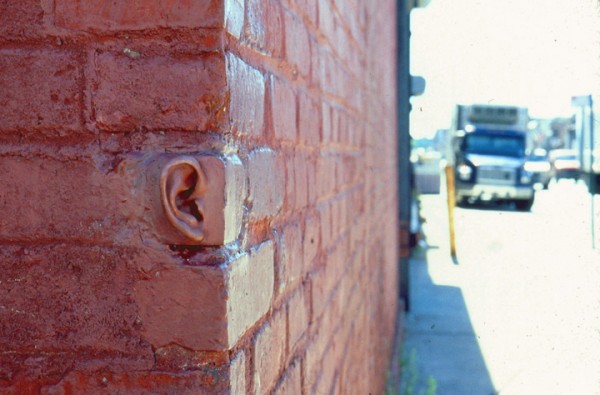
1. This ear on the wall by Michael Beitz
2. This cocktail table really sparkles.

3. I want this: a net that suspends you in mid-air as you read.

4. The magnetic one-handed zipper by Under Armour. (Click on link to see animation)


Many web-based companies are choosing to align their web and mobile interfaces so that their visual branding is the same on all platforms. The result is that websites begin to include mobile elements in their interface. Below are examples of how mobile design is influencing the web.
————————————————————————————————————————————————————————
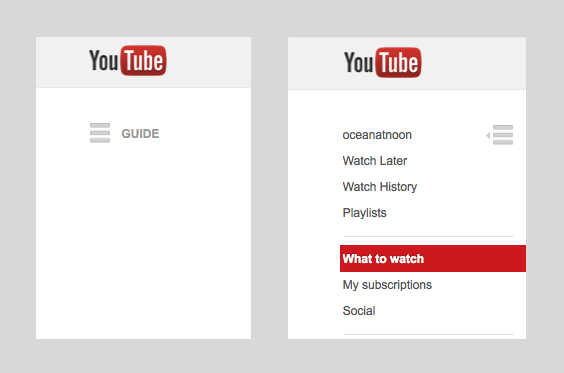
1. Basement Menus: YouTube is now using the “hamburger” icon to represent a hidden menu (usually to the left of the icon).
2. Circular profile icons were/are a mobile trend. (Designers sometimes places profile icons on top of product images in mobile to save on screen space). Now they’re on web too. [Below: Etsy]

3. Pinterest uses the default iOS 6 share icon for its share button. This icon has become universal to people to frequently use mobile software.

4. No, that’s not a screenshot of my phone. That’s responsive web below. Designers are choosing to optimize their websites for mobile, as well as using mobile-looking buttons and text fields for say…login screens.

5. Disclosure arrows are used in mobile to indicate that you can tap on a row or cell. They also show up on twitter (web) to let you know that you can see more Tweets, Following, Followers, etc.


No one expected me to go to art school. Not even I did. I was a bit of a conformist back in high school, taking tons of math and science classes so that I could please my parents and impress my peers. Painting was fun, but art school?
Now that I think about it, it’s probably because I had no clue what art school was actually about. People mostly see and hear about RISD through the media, which means they only get to know it as a place where kids with purple hair draw naked people (albeit, you do see plenty of that as a freshman).
What they probably don’t know about RISD is that it does the most amazing job of taking away fear – the fear of starting, the fear of trying something new, the fear of fear
Art and design push boundaries like nothing else, which is why RISD actually ended up being perfect for me. It made me do a lot of things that I was really uncomfortable with, which in hindsight ended up the best thing I could have ever done.
During my first semester as a freshman at RISD, I was given the assignment to build a violin from cardboard (FYI it didn’t have to work). I immediately started making calculations and measuring angles. The girl beside me simply traced an actual violin on cardboard, building each side as she progressed. Guess who finished first? Not me.
While high school taught me to be methodical about decisions, RISD taught me to hack things together until they worked.
RISD taught me to just start. Make something rough. Make it imperfect. Just make it, because it’ll get you further ahead than the person who’s still “measuring” the perfect way to do it.
I had never worked like this before in my life. Grade school never taught me how to make, so it was my first experience of getting my hands dirty and toying with creation.
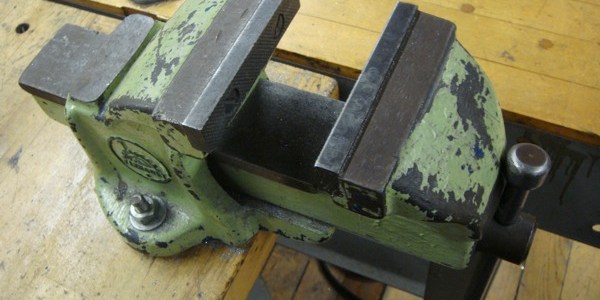
During my time in the industrial design (ID) department, I learned how to use a vacuum-form machine, a metal lathe and a blowtorch. If you had asked me high school whether I wanted to play with these machines, I would have probably backed away pretty quickly.
But the courses I took in ID required me to use them again and again, and as a result, they broke my fear of them. I practiced and practiced, until I realized nothing bad was going to happen to me while I used them.
By the end, I had hand-machined slider cranks, built foot pedals for sinks and soldered hollow-construction rings together.
RISD made me comfortable with fear. I became adjusted to trying new things on a regular basis; instead of being risk-averse, I became very risk-tolerant.
When you do this enough, it becomes more than a habit; it turns into an attitude, a mentality that you carry with you whenever you approach obstacles at work or in life. Instead of hesitating and worrying about whether the outcome is going to be perfect, you just dive in and see what it’s about.
While I’m not saying that art school does this for everyone, I am saying that sometimes, you just have to let go. Go and jump into something you’re afraid to do. You’ll look back and wonder why you ever feared it in the first place.













 The Design Ocean